I was standing at a sleek coffee shop counter in Phnom Penh, ready to pay for my iced latte. I handed the barista a crisp, clean-looking US twenty-dollar bill. She held it up to the light, turned it over, and then handed it back with a polite shake of her head. “Sorry, can you change this?” she asked. I looked closely: there was a tiny, barely visible crease at the bottom corner, less than two millimeters long. In most parts of the world, that bill is perfectly good money. In Cambodia, it’s completely useless. That morning taught me the first and most important rule of traveling here: cash is king, but only if that cash is absolutely flawless.
To avoid getting stuck without internet when trying to download local ride-hailing apps, coordinate minivans, or top up your digital wallets, purchase a high-speed Cambodia eSIM before you land. Having a working data connection makes navigating the kingdom’s unique payment and transit systems incredibly smooth.
1. Navigating Cambodian Transit: Apps, Highway Speed, and Tuktuks
Getting around Cambodia has evolved dramatically over the last few years. While you can still flag down rides on the street, digital ride-hailing apps are the safest, cheapest, and most transparent way to move within cities:
- The Ride Apps: Download Grab and PassApp before you arrive. Grab is excellent for linking your credit card, while PassApp is the local favorite and often has a higher concentration of drivers for quick three-wheeler hops. TADA is another great option popular in Phnom Penh that supports zero-commission bookings.
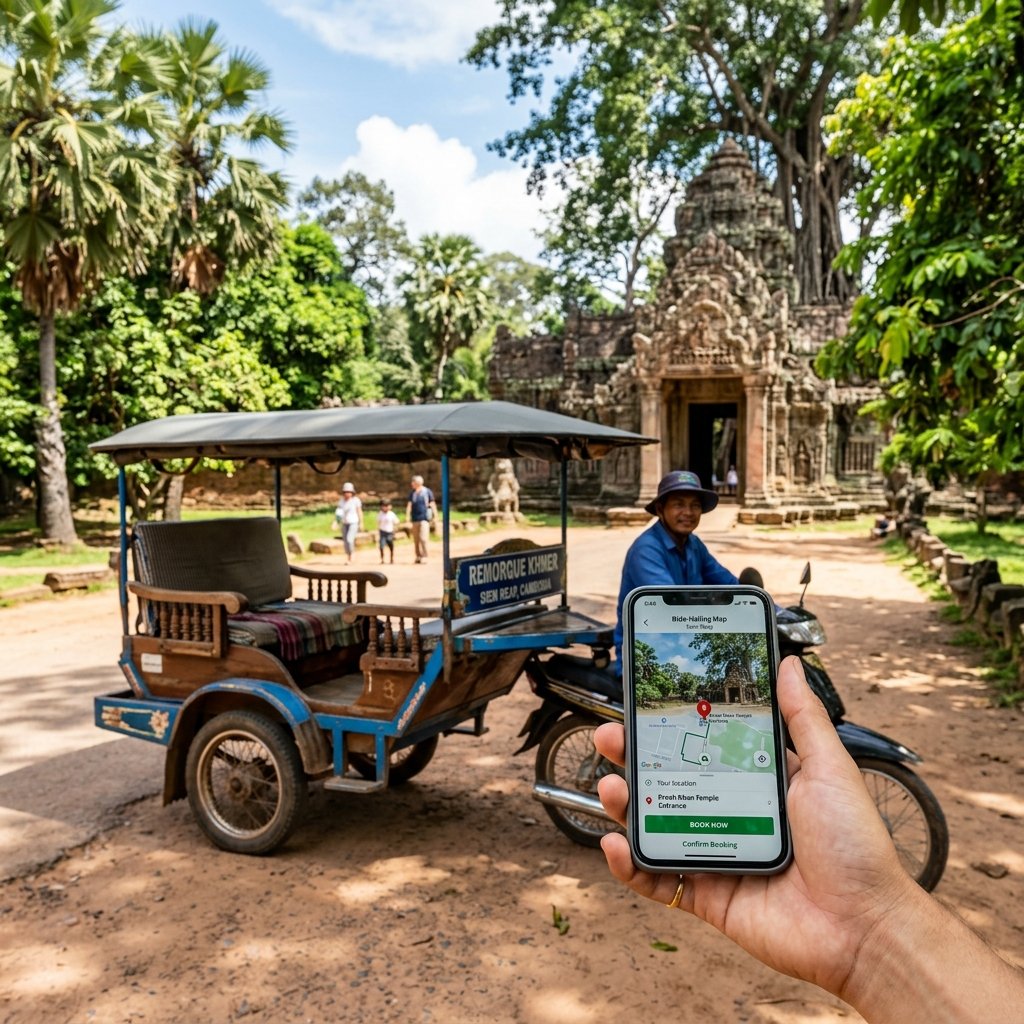
- Auto-Rickshaw vs. Remorque: When booking via apps, you’ll usually be dispatched a compact, Indian-style three-wheeled auto-rickshaw. They are fast and great for weaving through Phnom Penh’s hectic traffic. However, if you are temple-hopping in Siem Reap, hire a traditional Remorque (a wooden carriage pulled by a motorcycle). They are spacious, breezy, and offer fantastic 180-degree views of the ruins.
- The Sihanoukville Expressway: If you are traveling between Phnom Penh and Sihanoukville to catch a ferry to the islands, the modern Phnom Penh–Sihanoukville Expressway has cut travel times down from a exhausting 6-hour crawl to a smooth 2.5-hour highway drive.
- Siem Reap Travel: The 320km route between Phnom Penh and Siem Reap still takes **5.5 to 6 hours** along National Road 6, as it passes through multiple villages. Opt for premium VIP shared minivans (like Giant Ibis or Larryta Express) which feature speed limiters, air conditioning, and professional drivers rather than local public buses.
Island Transit Pro-Tip: Ferries to Koh Rong and Koh Rong Samloem depart from the Sihanoukville Autonomous Port (Tourist Pier). Book your high-speed speedboat tickets (via GTVC or Buva Sea) online in advance, and always double-check which pier your resort is located on, as the boats stop at multiple docks.
2. Cash & Currency: The Pristine USD and ATM Rules
Cambodia runs on a unique dual-currency system where the US Dollar (USD) and the Cambodian Riel (KHR) are used interchangeably. The unofficial rate is fixed at 4,000 KHR to 1 USD. You will pay for larger items in USD and receive riel back as change for fractions of a dollar.
- The Flawless Cash Rule: Any USD bill you carry must be absolutely pristine. Even the slightest fold, tear, ink mark, or stamp will result in it being rejected at restaurants, hotels, and markets. Keep your USD flat in a secure travel wallet. If a vendor hands you a damaged USD bill in change, politely ask them to replace it immediately.
- ATM DCC and Fees: Local ATMs charge a steep $4 to $8 fee per transaction for foreign cards. They also default to dispensing $100 or $50 notes, which are very difficult to break at small local shops. When using an ATM, if it asks whether you want to proceed with conversion, always select “Decline Conversion” to let your home bank handle the exchange rate.
3. Digital Payments: Using the Bakong Tourists App & KHQR
- The Bakong Tourists App: To bypass the cash headache, download the official Bakong Tourists app. It is a digital wallet launched by the National Bank of Cambodia for tourists. Once you verify your passport (KYC) and link your Visa or Mastercard, you can deposit funds and scan KHQR codes (universal local QR payments) at almost every shop, tuk-tuk, and food stall in the country, completely eliminating the need for pristine USD paper notes.
4. The Angkor Wat Code of Conduct
Visiting the ancient temples of Angkor is a bucket-list experience, but the park authorities enforce a strict code of conduct:
- Dress Code: Your shoulders and knees must be covered natively. Sleeveless shirts, tank tops, short skirts, or shorts are strictly prohibited. Wrapping a scarf or sarong over your shoulders at the temple gate is no longer allowed—you must wear actual clothing that covers these areas before you arrive at the checkpoint.
- Angkor Passes: Passes must be purchased online from the official **Angkor Enterprise** website or at the main ticket office. Passes are available as 1-Day ($37), 3-Day ($62), and 7-Day ($72) options. Keep your digital or printed pass secure, as tickets are checked at the entrance of every single temple.
- Hire Pink-Shirted Guides: If you want a tour guide, only hire those officially licensed by the Ministry of Tourism. You can recognize them by their official IDs and their light pink/peach collared uniform shirts. A licensed guide costs around $40 to $90 USD per day and is worth every penny to understand the rich history of the ruins.

5. Feasting on Khmer Flavors & Table Manners
Khmer food is subtle, fragrant, and heavily relies on fresh river fish and complex herb pastes. Be sure to check out these local specialties:
- Fish Amok: The national dish. A rich, coconut curry soufflé made with river fish and lemongrass paste, gently steamed inside a banana leaf.
- Beef Lok Lak: Stir-fried marinated beef served with a refreshing dipping sauce of lime juice, sea salt, and crushed local Kampot black pepper.
- Lort Cha: Zesty stir-fried short pin-noodles cooked with beef, bean sprouts, chives, and topped with a perfectly fried egg.
- Dining Etiquette: Cambodians use a spoon in their right hand and a fork in their left. Use the fork to push food onto your spoon, but never put the fork directly into your mouth. Chopsticks are reserved strictly for noodle soups.
- Tipping: While not mandatory, leaving a tip of $1 to $2 USD (or 4,000 to 8,000 KHR) for local drivers, tour guides, and hotel staff is a massive help and highly appreciated.
Check the r/cambodia community on Reddit for local advice.

6. Pre-Arrival Digital Rules: The e-Arrival Card
Cambodia has fully digitalized its immigration process. Within 7 days prior to your arrival, you must complete the official Cambodia e-Arrival (CeA) card at arrival.gov.kh or via their official mobile app. This single digital form replaces the old paper customs, immigration, and health declaration slips. Save the generated QR code to your phone to present at the border control.
Note that the CeA is not a visa. You must still purchase a Visa on Arrival ($30 in pristine USD cash) at the airport or apply in advance for an official e-Visa ($36 at evisa.gov.kh).
7. Beyond the Temples: Unmissable Spots & Connectivity
While Angkor Wat is the main draw, don’t miss the rest of what Cambodia has to offer. Spend a few days in the capital, Phnom Penh, visiting the stunning Royal Palace and learning about the country’s complex history at the Tuol Sleng Genocide Museum. Travel south to Kampot, a sleepy riverside town famous for its pepper plantations and French colonial architecture. Or catch a ferry to Koh Rong to relax on white-sand beaches and swim with bioluminescent plankton at night.
To easily book tuk-tuks, translate menus, and scan KHQR codes for payments with your Bakong wallet, purchase a high-speed Cambodia eSIM. It keeps you connected from the ancient stone towers of Angkor to the quiet shores of Koh Rong!

Frequently Asked Questions (FAQ)
Do I need a visa to travel to Cambodia?
Yes, most travelers need a visa for Cambodia. You can purchase a Visa on Arrival ($30 USD in pristine cash) at the airport, or apply for an official e-Visa ($36 USD) in advance at the official website evisa.gov.kh. You must also complete the Cambodia e-Arrival (CeA) card at arrival.gov.kh within 7 days prior to arrival.
What is the best mobile network connection in Cambodia?
Smart Axiata offers the best speed and coverage across Cambodia, followed by Cellcard. Buying a prepaid Cambodia eSIM before departure connects you directly to these high-speed networks upon landing.
Should I carry US Dollars or Riel in Cambodia?
Both are used interchangeably. However, US Dollar bills must be absolutely pristine with no folds or tears. To avoid cash issues, download the official Bakong Tourists app to scan local KHQR codes directly at shops and tuk-tuks.
 Cambodia eSim