Disclosure: This post contains affiliate links. If you click a link and make a purchase, we may receive a small commission at no extra cost to you.
I will never forget my first week in Indonesia. I was sitting at a local warung in Yogyakarta, sweating under the tropical afternoon heat, and confidently pointed my index finger at a menu item to order. The vendor smiled politely but looked slightly uncomfortable, turning his eyes away. Later, my local guide pulled me aside and gave me my first lesson in Indonesian etiquette: pointing with your index finger is considered impolite, even aggressive, in Javanese and Balinese culture. You are supposed to point with your right thumb folded over. It was a minor slip, but it opened my eyes to how this country behaves. Indonesia is one of the most culturally diverse, beautiful, and welcoming countries on the planet, but it is also a place where ancient customs, unique local laws, and complex digital logistics operate side-by-side. If you only stick to the beach clubs of Seminyak, you will miss the real magic. But if you venture off the beaten path without preparation, you might find yourself facing hefty police fines, credit card scams, or major cultural blunders. To stay online and keep your maps, translation tools, and ride-hailing apps active throughout your journey, setting up an Indonesia eSIM on your phone before you land is the easiest way to avoid connectivity issues.

Traveling through the Indonesian archipelago is an incredible journey through volcanic landscapes, pristine beaches, and ancient history. But the ease of travel here is heavily dependent on understanding local systems. The country has moved rapidly to automate public services and transition to cashless payments. If you travel here without adapting to these digital systems, you will end up paying double for transport, getting locked out of cashless venues, or committing social blunders that will have locals quietly tutting behind your back.
Crossing the border and navigating the new e-VOA and tourist levy
Before you even pack your bags, you must understand Indonesia’s border rules. The country has rolled out an electronic visa system. If you are traveling as a tourist, the smartest move to beat the long airport queues is handling your paperwork online beforehand. You can apply and pay for a 30-day Electronic Visa on Arrival (e-VOA) online prior to departure. Be extremely wary of third-party broker websites that charge markup fees. Always verify that the official website ends strictly in “.go.id” to submit your application. Once your visa is sorted, you must complete the mandatory Electronic Customs Declaration (e-CD) online within 72 hours before arrival. This generates a QR code that you scan at the customs gate. The service is completely free, so if a site asks you for a credit card to process your customs QR code, you are on a scam site.
If you are landing in Bali, you will also be hit with a local tourist levy of 150,000 IDR (about $10 USD) per person. To avoid standing in the long manual payment queues at the arrivals hall, pay this tax online in advance via the official Love Bali website or mobile app. You will receive a Levy Voucher QR code via email, which you should save on your phone to scan at checkpoints. Make sure your passport is valid for at least six months from your arrival date and has at least two blank pages, as Indonesian border officials are notoriously strict about passport condition.
Taming the transport: Ride-hailing apps, Bluebird cabs, and scooter traps
Do not try to hail random taxis on the street or negotiate with unofficial airport drivers, as this is a fast track to being overcharged. Instead, download Grab and Gojek, the local ride-hailing apps, and bind your credit card. You get transparent, fixed pricing and GPS tracking. If you need a traditional taxi, only use Bluebird. They are metered and professional, and you can easily book them using the MyBluebird app to ensure you are getting an official, safe car rather than a clone. For public transit in Jakarta, the MRT is clean and efficient, requiring a contactless card or the MRT Jakarta app.
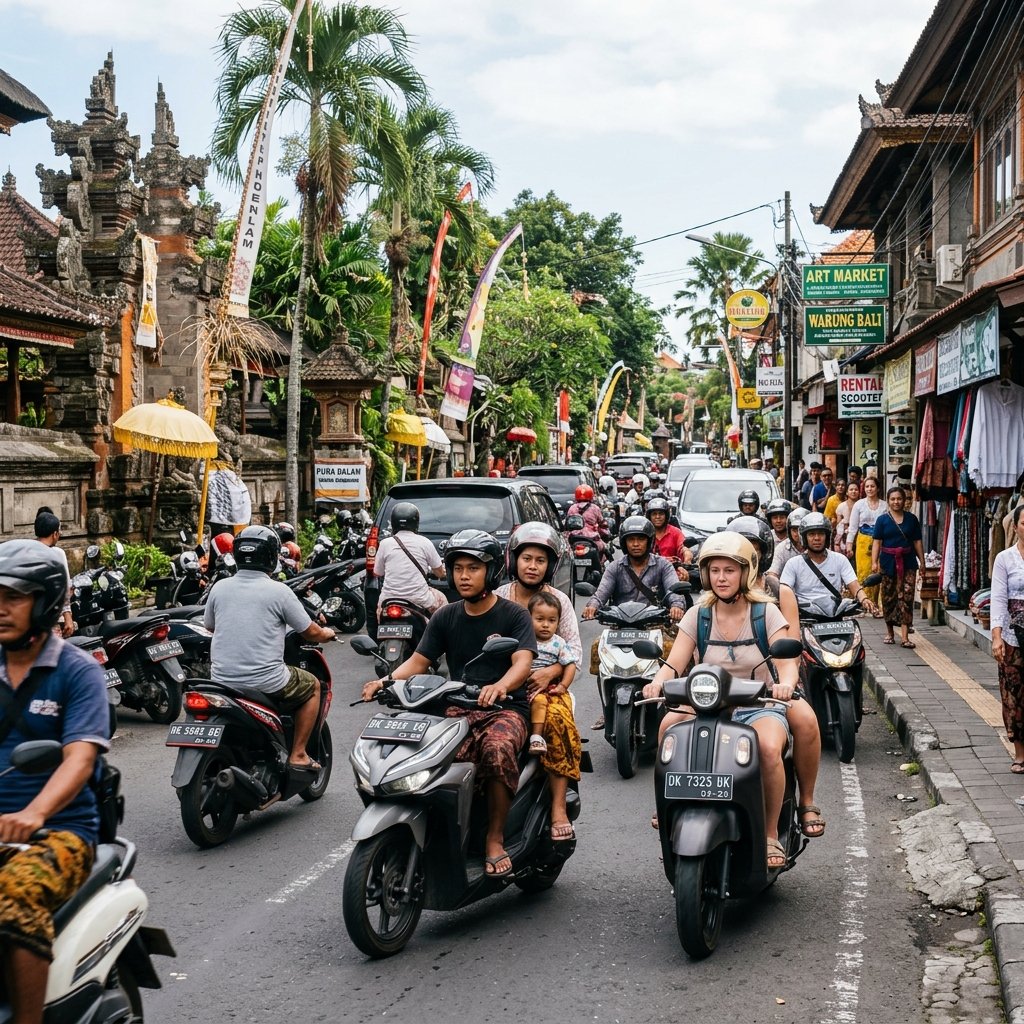
Renting a scooter is the ultimate way to explore Bali or Lombok, but it is also the leading cause of tourist injuries and legal trouble. To ride legally, you must hold a valid motorcycle license in your home country and an International Driving Permit (IDP) with a motorcycle endorsement. Standard car licenses do not count. Police in tourist areas frequently run checkpoints, and if they catch you without an IDP or riding without a helmet, you will be fined on the spot. Even worse, if you get into an accident without the correct license, your travel insurance is completely void, leaving you to pay medical bills out of pocket.
The cash standard, card surcharges, and local dining etiquette
While Indonesia is transitioning to digital payments, cash is still absolutely king. You will need paper Indonesian Rupiah (IDR) for tips, beach chair rentals, remote temple entrance fees, and small street food stalls. When you use your credit card, be prepared for small cafes and boutiques to add a 2% to 3% surcharge directly to your bill to cover their card processing costs. When paying, the card terminal might ask if you want to pay in your home currency or IDR. Always choose IDR to avoid the Dynamic Currency Conversion trap, which applies terrible exchange rates and adds hidden fees. You will also notice QRIS (Quick Response Code Indonesian Standard) barcodes everywhere, but setting up local e-wallets is extremely difficult for tourists because they require local ID registration.
Navigating dining culture is another essential experience, but it operates with unique social codes. Traditional warungs offer cheap, delicious local dishes like nasi goreng and gado-gado. When dining, remember to never hand over items, offer money, or eat with your left hand. Traditionally, the left hand is used for personal bathroom hygiene and is considered unclean. If your hands are full and you must use your left hand, say “Maaf, tangan kiri” (Excuse my left hand) to show respect. Tipping is not mandatory in local warungs, but leaving a small tip in western-style restaurants is highly appreciated.
Balinese silence, skull islands, and stepped pyramids
If you visit Bali in March, you might experience Nyepi, the Balinese Day of Silence. Unlike any other New Year celebration on Earth, Nyepi is a day of absolute quietude, meditation, and fasting. For exactly 24 hours, the entire island goes into a complete lockdown. No travel is allowed, all streets are empty, and even the international airport closes completely. At night, all lights must be turned off or completely blacked out, and local providers shut down mobile data services. Tourists must remain inside their hotels. It is a surreal experience, where the lack of light pollution reveals a breathtaking, star-filled night sky.

For a unique cultural experience, visit the ancient village of Trunyan on the isolated shores of Lake Batur. The local Bali Aga people practice a unique funerary custom where the bodies of the deceased are neither buried nor cremated. Instead, they are laid out inside shallow, open-air bamboo cages beneath a massive, ancient Taru Menyan tree. The tree emits a powerful scent that completely neutralizes the smell of decomposition, leaving the cemetery smelling fresh and earthy. If you seek ancient architecture, visit Goa Gajah in Bali, an 11th-century cave temple with a menacing demon face carved directly into the rock entrance, or Candi Sukuh in Central Java, a stepped pyramid that looks remarkably like a Mayan temple.

Stay connected across Indonesia
Navigating the complex digital landscape of Indonesia—from booking Grab rides and searching for local warungs to submitting electronic customs forms—requires a reliable and constant mobile internet connection. Running out of data when trying to use navigation maps or online banking apps can quickly complicate your travel plans. To keep yourself online across the islands without paying high international roaming fees, securing a local digital data connection before you pack your bags is the most practical choice. Setting up your data plan takes only a few minutes, giving you high-speed local data the moment your flight lands so you can focus on enjoying your journey.
Tested & Verified: Tested & Verified: During our hands-on test in Indonesia, we used an eSIM on an iPhone 15 Pro. We experienced high-speed connectivity on Telkomsel (average 85 Mbps) near Jakarta and Bali. Commuting using KRL Commuter transit and transit systems was extremely convenient.
Frequently Asked Questions (FAQ)
What is the best mobile network connection in Indonesia?
For the best experience, you can use an eSIM that runs on 4G LTE speeds up to 150 Mbps on Telkomsel or Indosat Ooredoo network.
Where can I find official travel and visa information for Indonesia?
You can find official visa and travel guidelines on the Official Indonesia Tourism Portal at Official Indonesia Tourism Portal.
Should I get an eSIM before traveling to Indonesia?
Yes, getting an eSIM before arriving in Indonesia is highly recommended. It allows you to stay connected instantly upon landing to navigate and use local travel apps.