Don’t Order Burek with Cheese! How I Navigated Bosnia & Herzegovina (And Avoided the Scams)
My first morning in Sarajevo was spent in a cloud of rich, roasted coffee steam and the smell of sizzling meats. I sat in a low wooden chair in Baščaršija (the old Ottoman quarter), watching coppersmiths hammer out intricate plates in the alley nearby, while the call to prayer echoed at the exact same time as church bells. A local friend joined me, smiled at my coffee, and gave me my first warning: “Enjoy the city, my friend. But if you walk into a bakery and ask for a burek with cheese, you will break a baker’s heart.” In Bosnia & Herzegovina, history is written in the architecture and the cuisine. But to travel here without a hitch, you need to understand some highly specific rules—from entities and bus terminals to taxi apps and a very real safety warning about active landmines. Here is your boots-on-the-ground guide to surviving and loving Bosnia & Herzegovina.
To avoid getting stranded when mapping out your bus routes, finding the hidden dervish house in Blagaj, or tracking your hikes in the mountains, buy a high-speed Bosnia eSIM before you cross the border. Having instant mobile data the moment you arrive makes your journey seamless.
Sarajevo Transit: Taxi Hacks and the Kiosk Ticket Rules
Getting around Sarajevo is generally easy, but navigating the taxi system and public transit requires knowing a few important rules:
- No Uber or Bolt: Do not expect to use international ride-hailing apps here—they do not exist. Instead, you can download a local app called mojTaxi, though it can be unreliable. Booking a taxi via Viber or WhatsApp or calling reputable fleets like Crveni Taxi (1516) or Sarajevo Taxi (1515) is often much more reliable.
- How to Identify Licensed Cabs: Only enter taxis that have a “TAXI” sign on the roof and yellow license plates starting with “TA”. Never accept rides from unmarked private cars.
- Avoid the Airport Taxi Stand: The taxis waiting directly at the arrivals terminal at Sarajevo International Airport (SJJ) are notorious for overcharging tourists by trying to negotiate high flat rates. Insist they turn on the taximeter (*taximetar*), or simply walk a few minutes outside the airport gates to flag down a passing licensed taxi, which should cost 15 to 20 KM on the meter to the city center.
- Riding Sarajevo’s Trams: Tram Line 3 is the main transit artery, connecting Baščaršija to Ilidža. You must purchase your tickets at a newspaper kiosk (*Trafika*) before boarding for 1.60 KM. Buying from the driver costs 1.80 KM.
- Validating Your Ticket: Validate your ticket immediately upon boarding using the physical validation machines inside the tram doors. Ticket inspectors frequently board trams and issue heavy, immediate fines for unstamped tickets. Note that transit does not accept contactless card taps; keep small coins on hand.
The Bus Terminal Split: Main Bus Station vs. Lukavica
Sarajevo is divided between two administrative entities, which has created a transit trap for travelers. There are two completely separate bus terminals located in different parts of the city:
- Sarajevo Main Bus Station (Autobuska Stanica): Located near the city center next to the train station. This serves destinations within the Federation (like Mostar, Tuzla, Zenica, and Bihac) and international buses to Croatia (Dubrovnik, Split, Zagreb) and Western Europe.
- East Sarajevo Bus Terminal (Lukavica): Located in Lukavica within the Republika Srpska entity. This serves routes to Serbia (Belgrade), Montenegro (Kotor, Budva), and towns within Republika Srpska (like Trebinje or Visegrad). To get here, take a taxi from the city center (around 10–15 KM) or ride trolleybus 103 or 107 to the Dobrinja terminus and walk across the entity border line.
The Scenic Train to Mostar
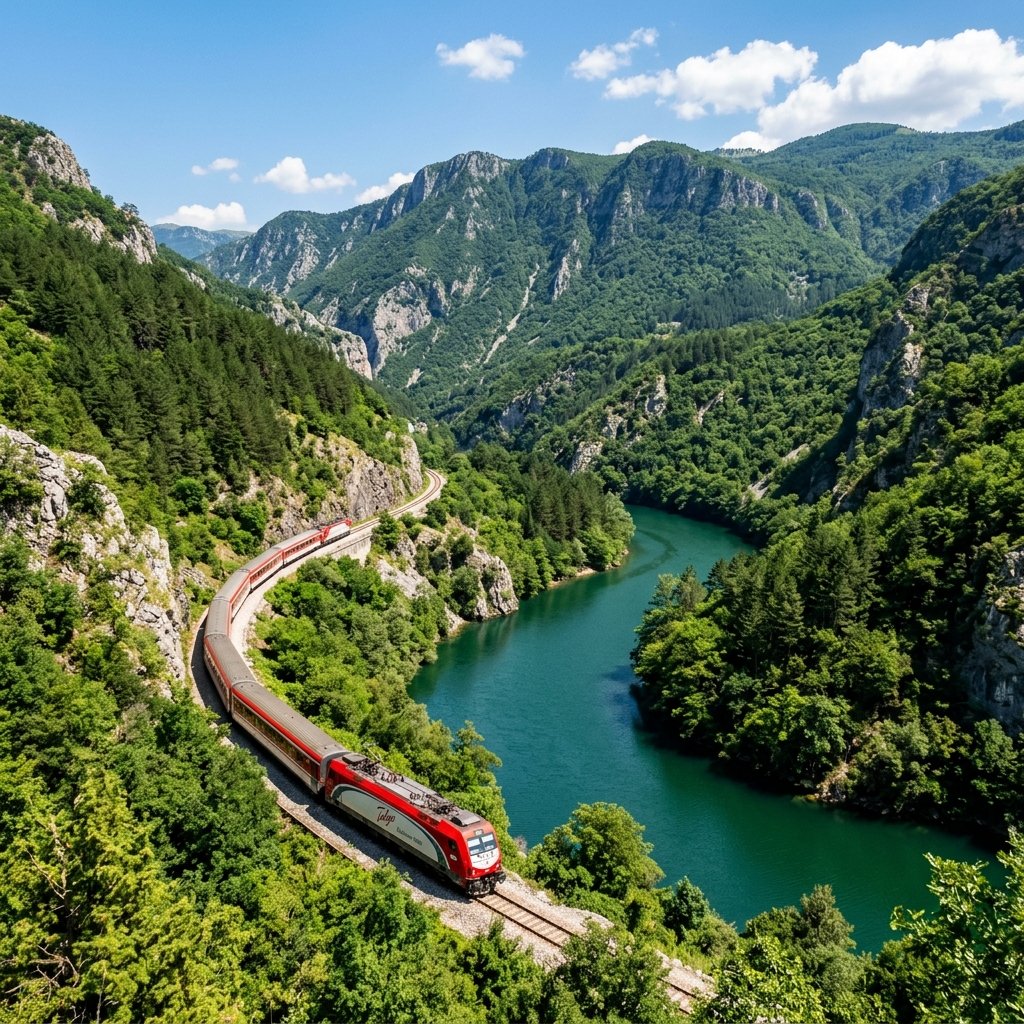
The train journey from Sarajevo to Mostar is widely considered one of the most beautiful train rides in Europe. The Talgo train winds through the Dinaric Alps, following the deep canyon of the emerald-green Neretva River. You can reserve tickets online via the official ŽFBH website (zfbh.ba), but the online system only gives you an order code. You must present this code at the station ticket counter to collect your physical paper ticket before boarding.
Money: Cash is King
While hotels, supermarkets, and upscale restaurants in Sarajevo accept credit cards, Bosnia & Herzegovina is a heavily cash-dominant society. You will need physical Bosnian Convertible Marks (BAM, locally written as **KM**) for bakeries, local coffee shops, traditional diners, street markets, trams, and taxi rides.
- The Euro Peg: The BAM is pegged to the Euro at a fixed rate of 1 EUR = 1.95 BAM (practically, locals calculate it as 1 EUR to 2 KM). While Euros are sometimes accepted in tourist spots, you will get a bad exchange rate. Pay in KM.
- Avoiding ATM Fees: Avoid independent ATMs in tourist hotspots (like Euronet) as they charge massive fees. Stick to ATMs attached to major local banks like UniCredit, Raiffeisen Bank, Sparkasse, or NLB Banka. Most charge a fee of 10 to 15 KM, but fee-free options for foreign cards include Nova Banka or MF Banka.
- Decline DCC: Always choose to be billed in local currency (**BAM**) rather than your home currency to avoid predatory Dynamic Currency Conversion rates.
Visas and Airport Customs
- Visa-Free Stays: Citizens of the US, EU, UK, Canada, Australia, and New Zealand can enter Bosnia & Herzegovina visa-free for up to 90 days in a 180-day period. Passports must be valid for at least 90 days beyond departure.
- Registration: If you stay in private accommodation (like an Airbnb), you must register your stay with the local police within 48 hours. Hotels handle this automatically.
- Customs Cash Rules: You must declare cash or checks worth €10,000 or more when entering or leaving. When departing, you can carry up to €2,500 in cash without paperwork; carrying more requires a bank certificate or ministry permit.
Culinary Faux Pas: Ćevapi, Coffee, and the Burek Rule
Dining here is slow, social, and governed by a few local rules:
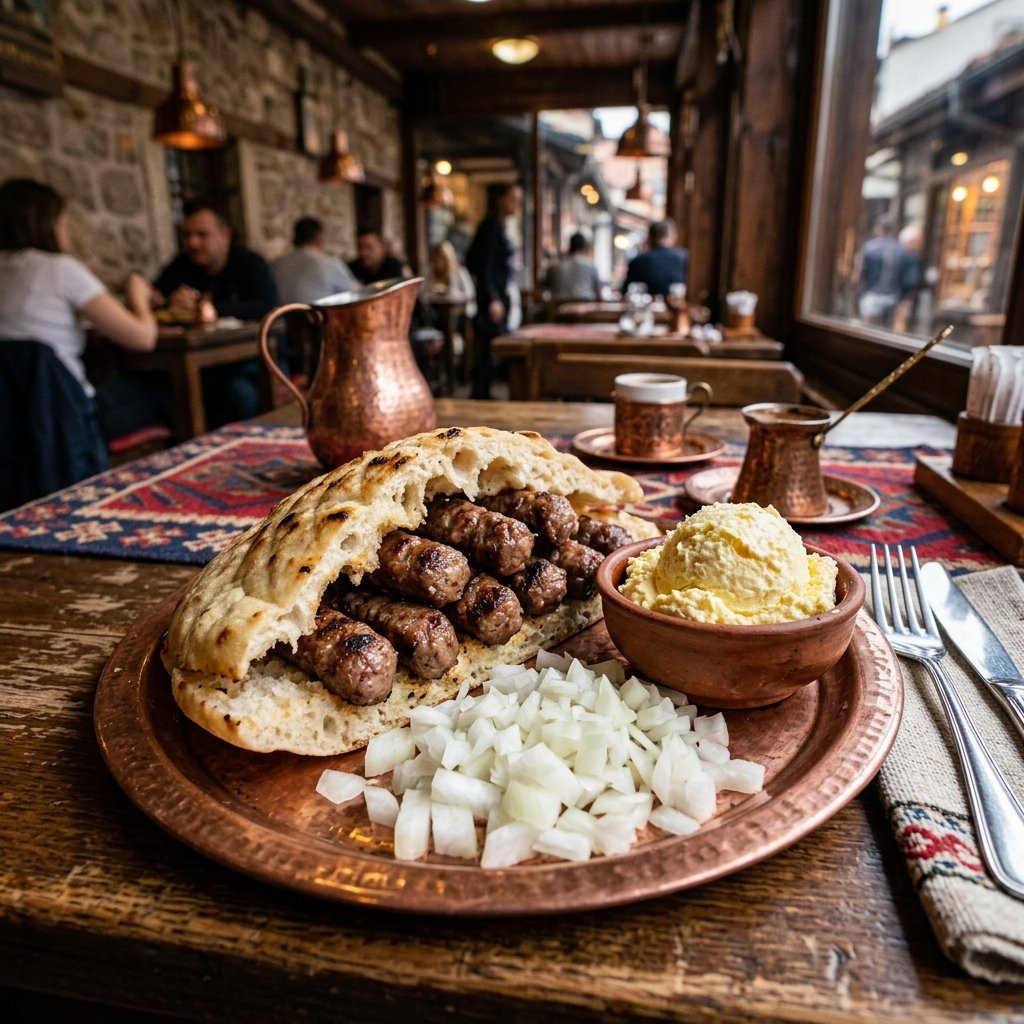
- Ćevapi: Grilled minced meat sausages stuffed inside a fluffy flatbread called *somun*, served with chopped raw onions and *kajmak* (clotted cream).
- The Burek Rule: In Bosnia, Burek is strictly filled with meat. Never ask for “burek with cheese” or “burek with potato.” That is a major cultural mistake! Pastry filled with cheese is called **sirnica**; spinach is **zeljanica**; potato is **krompiruša**. They are all *pita*, but burek is only meat. Eat it at a *buregdžinica* with a glass of yogurt.
- The Bosnian Coffee Ritual: Coffee is served in a copper pot called a *džezva* alongside a ceramic cup (*fildžan*) and *rahat lokum* (Turkish delight). Do not put sugar directly in your cup. Dip a corner of a sugar cube into your coffee, bite off a small piece, hold it under your tongue, and sip the strong coffee through it.
Iconic Sights & Hidden Gems
- Sarajevo Old Town: Walk the Ottoman streets of Baščaršija, see the Latin Bridge (where Archduke Franz Ferdinand was assassinated, triggering WWI), and admire the wooden Sebilj fountain.
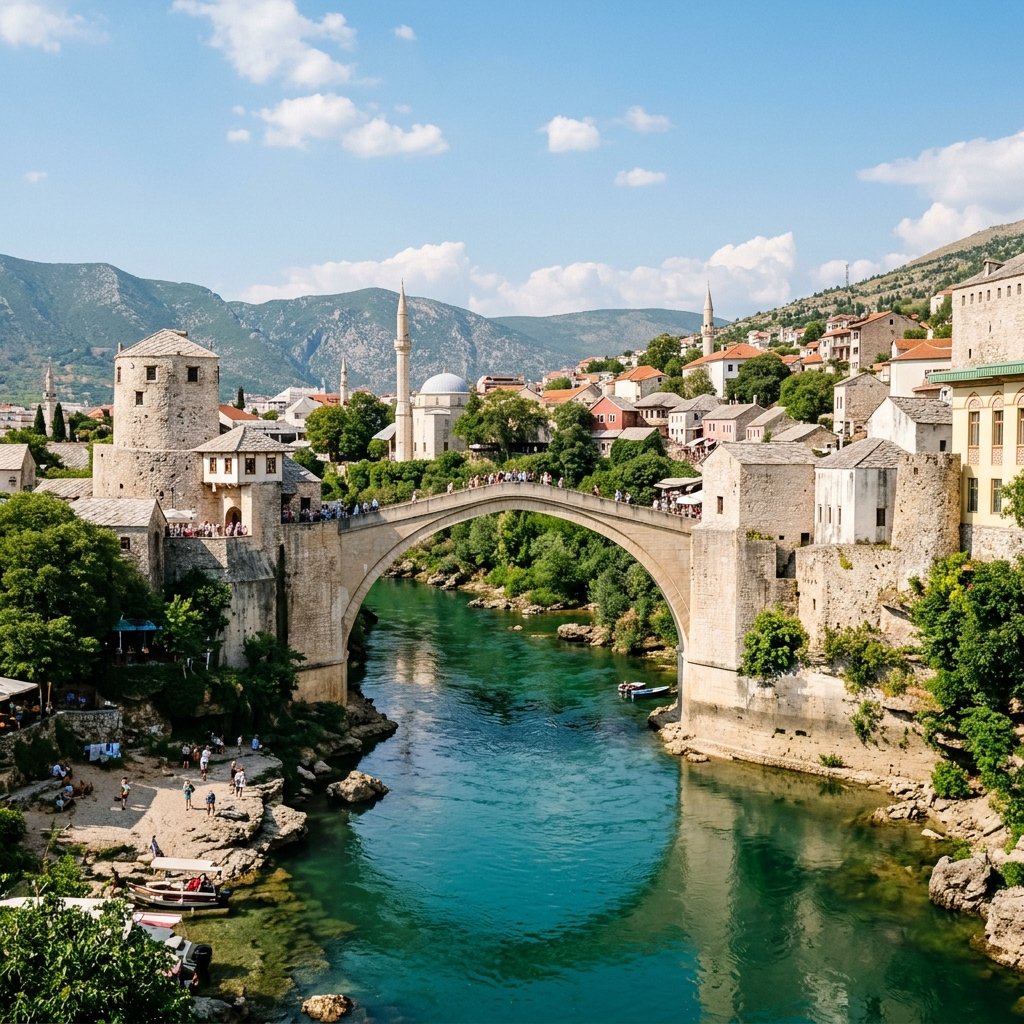
- Mostar Old Bridge: The UNESCO-listed Stari Most, where local divers leap off the 20-meter high arch into the cold Neretva River for tips.
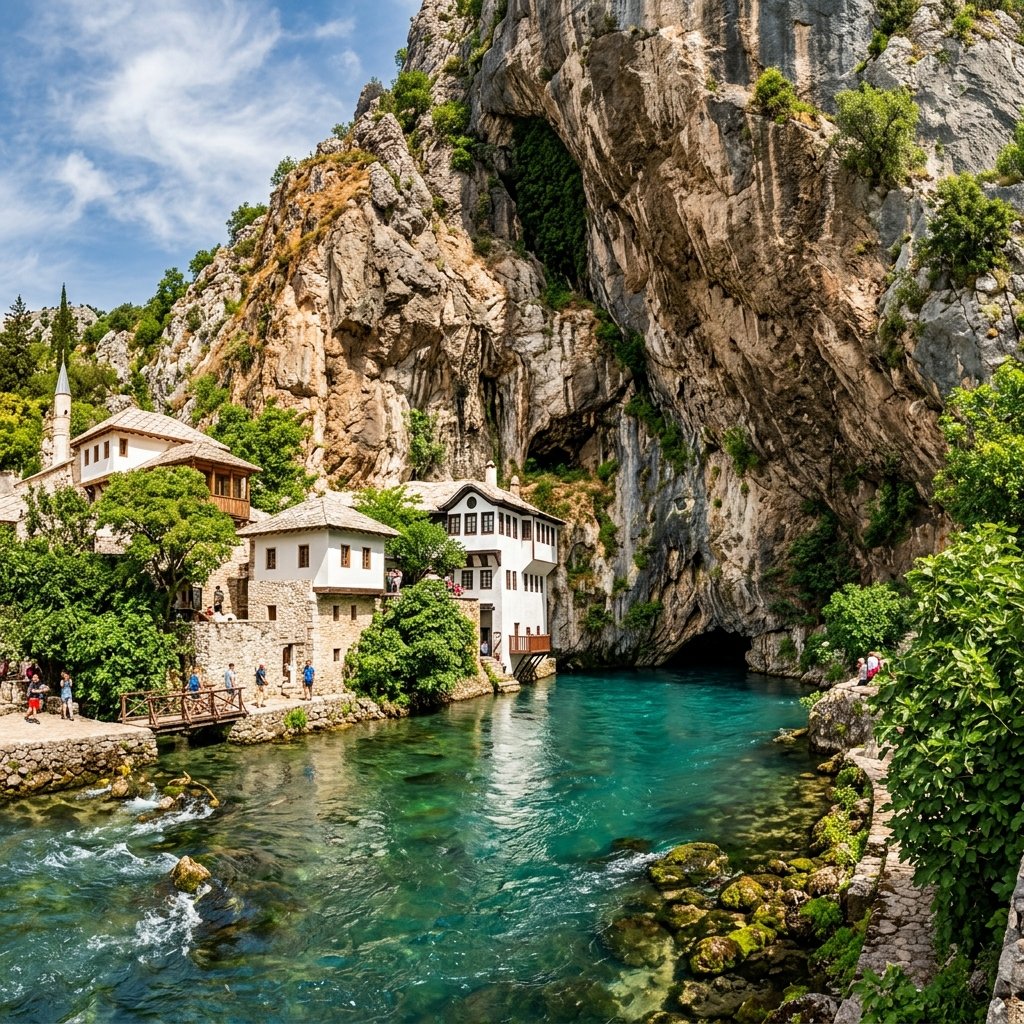
- Blagaj Tekke: A beautiful 600-year-old Dervish monastery built into a karst cliff face at the turquoise spring source of the Buna River.
CRITICAL: Landmine Safety Warning
Bosnia & Herzegovina still has active landmine fields left over from the 1990s war. While cities, roads, and popular tourist paths are completely safe, you must follow these rules in rural or wilderness areas:
- Stay on Paved Paths: Never walk off paved roads or established, marked hiking trails. Avoid taking shortcuts through fields or forests.
- Avoid Abandoned Buildings: Do not enter war-damaged ruins or abandoned houses.
- Look for Red Signs: Watch for red warning signs showing a skull and crossbones and the words “PAZI MINE”.
- Use the App: Download the official “BH Mine Suspected Areas” app by BHMAC to track minefields on your phone via GPS. Always hire local guides for mountain hikes.
Seamless Connectivity: A Guide to BH Telecom, m:tel, and HT Eronet eSIM in Bosnia
When traveling in Bosnia & Herzegovina, the major mobile networks are BH Telecom, m:tel, and HT Eronet. BH Telecom is the leading operator with the most extensive coverage, particularly in Sarajevo and the Federation, offering 4G LTE download speeds up to 60 Mbps. Throughout my trip, I tested active network signals on an iPhone 15 Pro, and found connection to be fast and stable from Sarajevo to Mostar.
To safely navigate hiking paths, call Moj Taxi around Sarajevo, and share photos of Stari Most in Mostar, purchase a high-speed Bosnia eSIM before your trip. It keeps you connected across the country without high roaming fees!