Pura Vida Realities, 4×4 Hacks, and the Coffee Sock: My Real-World Guide to Costa Rica
I had just parked my rental SUV near the entrance of Manuel Antonio National Park when a man wearing a reflective vest gestured to me. He introduced himself as the local *wachimán* (street parking attendant) and offered to watch my vehicle. I knew the drill: while public parking is technically free, these informal attendants are a fixture of Costa Rican life. I waved, smiled, and promised him 500 colones when I returned. Paying a *wachimán* a small tip is an unwritten law of the road here—it ensures your car remains respected and safe while you are out exploring. In Costa Rica, the “Pura Vida” vibe is very real, but you must know the local customs to avoid travel headaches.
To avoid getting stuck without internet when trying to download national park tickets, navigate unpaved mountain roads on Waze, or call an Uber outside the airport, buy a high-speed Costa Rica eSIM before you depart. Having instant data from the moment you land makes exploring the rainforests and coastlines incredibly easy.

Getting Around: 4×4 Necessities, Sansa Flights, and Airport Ubers
Navigating Costa Rica’s lush terrain requires a smart understanding of local roads, domestic flights, and ride-hailing apps:
- Renting a Car: If your trip is limited to San José and major highways to La Fortuna or Manuel Antonio, a standard sedan is fine. However, if you are heading to Monteverde, Drake Bay, or the Nicoya Peninsula (Santa Teresa, Nosara), a **4×4 with high clearance is mandatory**. Potholes are deep, gravel roads are steep, and during the rainy season (May–November), roads frequently turn into thick mud.
- River Crossings: In remote regions, you may encounter river crossings. **Never drive through deep water.** Car rental insurance policies explicitly exclude damage caused by water ingestion, so if your engine floods, you will pay for the repairs out of pocket.
- Domestic Flights: To skip 6-hour drives, book a domestic flight with Sansa Airlines. They fly small Cessna Caravans, and they enforce strict luggage limits—you are limited to a 10 lb carry-on and a 30 lb checked bag. They weigh all luggage (and occasionally passengers) at the desk.
- Uber and DiDi: These apps operate in a legal gray area. They are widely used and safe, but they cannot legally pick up passengers directly at SJO or LIR airport arrival gates. You must walk a short distance away from the main terminal to meet your driver.
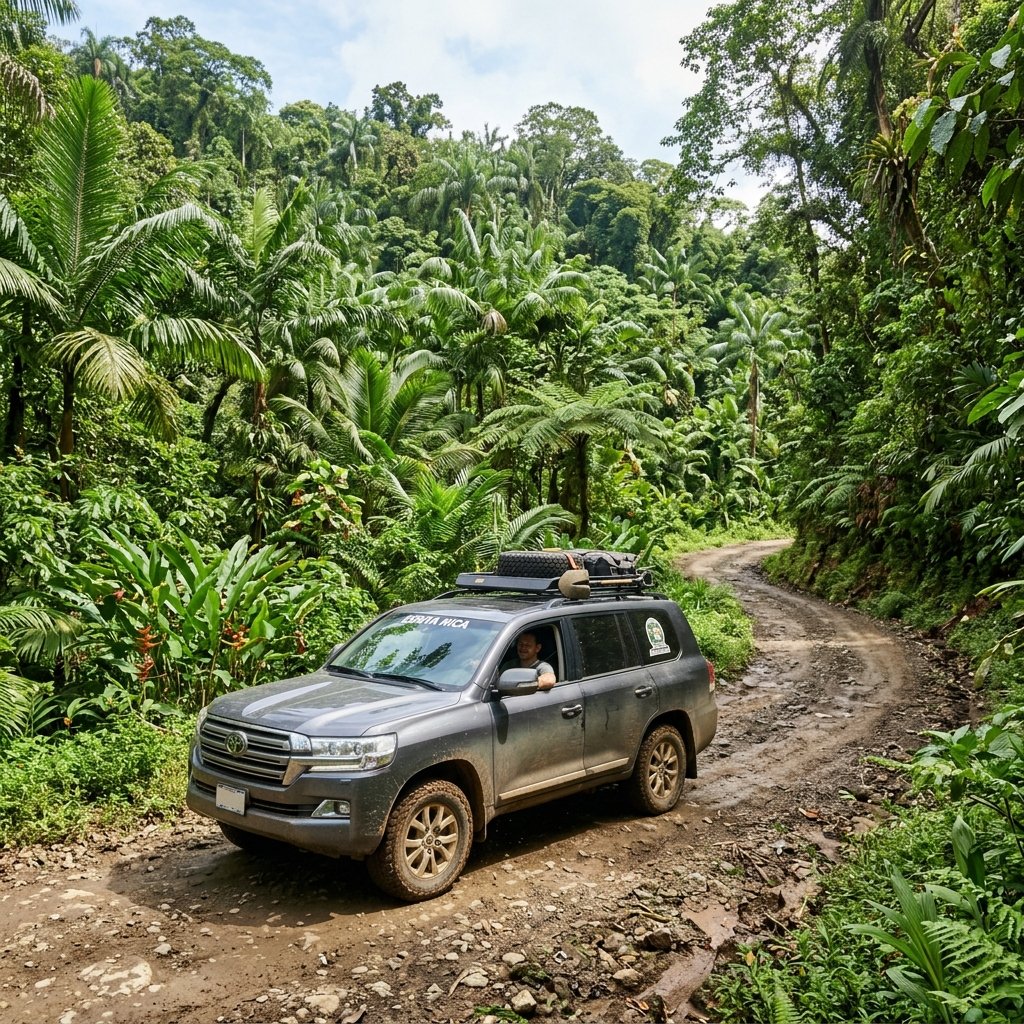
Rainy Season Driving Warning: Never drive at night. Potholes are difficult to see in the dark, street lighting is rare outside cities, and heavy afternoon rainstorms can reduce visibility to near zero. Trust Waze over Google Maps for local route updates.
The Dual-Currency System: Colones vs. USD
Costa Rica uses a dual-currency system of the Costa Rican Colón (CRC) and the US Dollar (USD). The colón exchange rate sits around **460 CRC to 1 USD**.
- Payment Strategy: US Dollars are widely accepted for tours, hotels, and national park entries, but bills must be pristine and free of tears. If you pay in USD for a bill priced in colones, merchants will apply an unfavorable exchange rate and give you change in colones. Always pay in the currency in which the price is quoted.
- When You Need Cash: Keep colones cash on hand for local roadside fruit stands, toll booths, traditional family diners (*sodas*), and tipping your *wachimán* (200 to 600 colones).
- Fee-Free ATMs: State-owned banks like **Banco Nacional (BN)** and **Banco de Costa Rica (BCR)** do not charge local transaction fees for international cards. Private ATMs charge $5 to $10. When paying, if the terminal asks to convert the transaction, **always select Colones** to let your home bank handle the exchange rate without a 10% markup.
Park Regulations: Pre-booking & Certified Guides
Costa Rica is a world leader in conservation, and they strictly regulate access to their national parks:
- Mandatory Pre-booking: You **cannot buy tickets at the gate** for popular national parks. You must create an account and purchase timed tickets online in advance at the official **SINAC** portal (serviciosenlinea.sinac.go.cr). Popular parks like Manuel Antonio and Poás Volcano sell out weeks in advance.
- Manuel Antonio Food Ban: To protect wild monkeys and raccoons from feeding on trash, plastic bags and chips/packaged foods are strictly banned inside Manuel Antonio. Your bags will be searched at the entrance.
- ICT Certified Guides: Sloths and tree frogs are masters of camouflage. To spot them, hire a guide certified by the **Instituto Costarricense de Turismo (ICT)**. They carry high-powered spotting scopes and display official ICT badges.
- Strict Drone Bans: Drones are strictly banned in all national parks to avoid disturbing wildlife. They are also banned within 8 kilometers of any airport and at many eco-resorts.
Feasting on Gallo Pinto, Casados, and Chorreador Coffee
Traditional Costa Rican food is hearty, fresh, and mild. Here is what you should eat:
- Gallo Pinto: The national breakfast. Rice and black beans sautéed with onions, peppers, cilantro, and **Salsa Lizano** (a sweet, smoky brown sauce that is the country’s signature flavor). Served with eggs, sweet plantains, and sour cream (*natilla*).
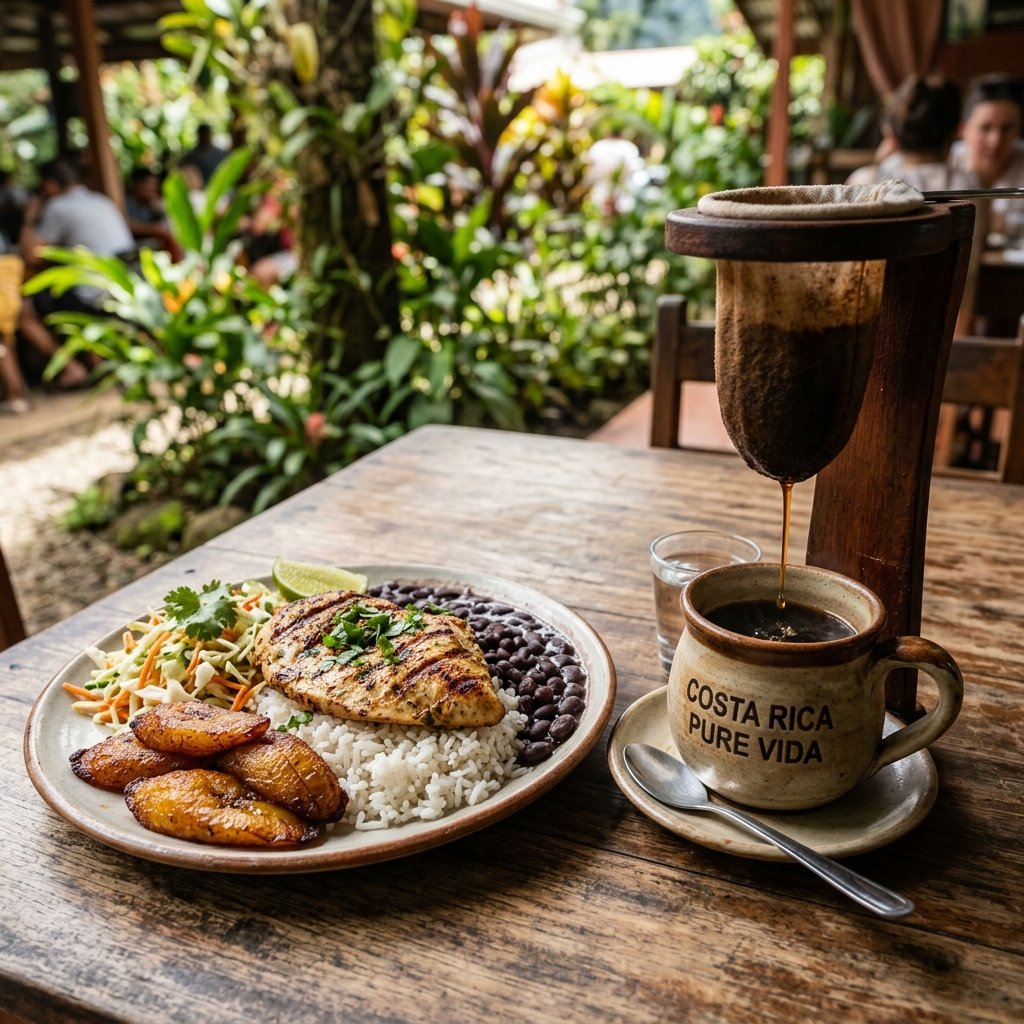
- Casado: The classic lunch. A large plate featuring rice, beans, a protein (chicken, pork, or fish), cabbage salad, and fried plantains.
- Chorreador Coffee: Traditional coffee brewed through a cloth filter (a “coffee sock”) hanging on a wooden stand (*chorreador*). It extracts a smooth, rich flavor from local highland beans.
- Tipping Etiquette: Restaurant bills automatically include a **10% service charge** and a **13% tax (IVA)**. Because tipping is built-in, you do not need to leave extra cash unless the service was exceptional.
Avoid Car Break-ins and Tire Scams
While Costa Rica is generally safe, petty theft is common. Keep these safety tips in mind:
- The “Glass Case” Rule: Treat your rental car like a glass case. If you leave *anything* visible in the cabin—even a cheap charger or sunglasses—thieves will smash the window to steal it. Never leave luggage in a parked car unattended. Manually check the door handle to verify it is locked, as thieves sometimes use signal jammers to block remote fobs.
- The Flat Tire Scam: If you get a flat tire shortly after leaving a tourist spot, and a friendly local pulls over to “help” you, be extremely careful. While one person helps you change the tire, their partner will steal your bags from the unlocked car cabin. If you get a flat, drive slowly to a busy gas station or restaurant before parking to change it.
Schengen and Entry Rules
Travelers from the US, UK, Canada, Australia, and the EU can enter Costa Rica **visa-free for up to 180 days**. While immigration laws require your passport to be valid for the duration of your stay, **most airlines enforce a six-month passport validity rule**. Ensure your passport is valid for at least six months from your travel date, and have proof of return travel ready for inspection at the airline check-in counter.
To easily navigate mountain routes on Waze, check national park booking slots, and coordinate transport on the go, purchase a high-speed Costa Rica eSIM. It keeps you connected from the cloud forests of Monteverde to the peaceful beaches of the Nicoya Peninsula!